
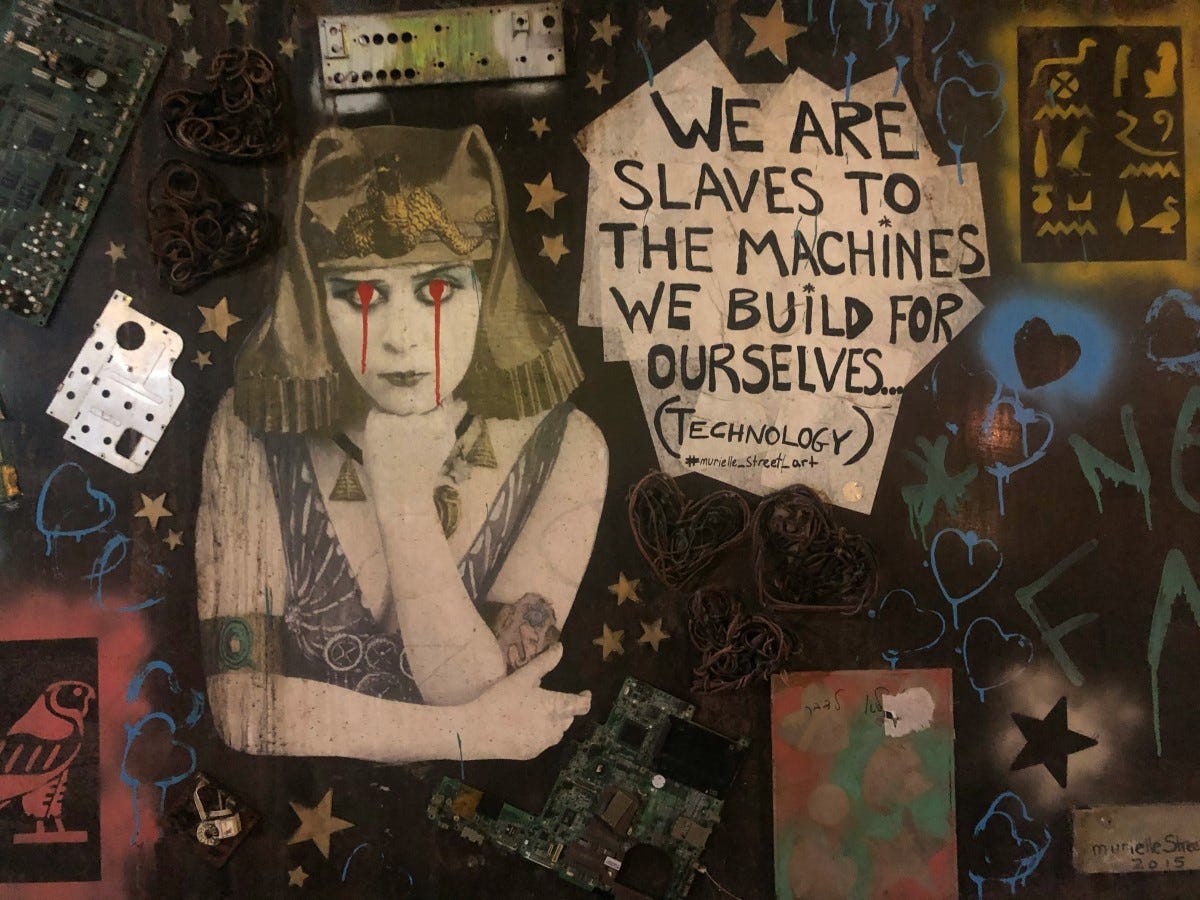
I’ve been revisiting posts from the early days when Things Invisible to See had just a handful of readers. This post came to mind when I found out I’ll be editing a high-school lesson on E.M. Forster’s story “The Machine Stops.” I still think we’re incredibly lucky that the author of A Room with a View wrote this prescient sci-fi masterpiece. Here is an edited version of my 2022 post about it.
I stumbled across E.M. Forster’s story “The Machine Stops” online years ago, and his dystopian vision still haunts the edges of my thoughts. When I think about technology, social media, and the relationship between ideas and reality—or when I just have that dazed, floaty feeling from spending too much time staring at screens—I picture the story’s main character, Vashti:
And in the armchair there sits a swaddled lump of flesh - a woman, about five feet high, with a face as white as a fungus.
It doesn’t help that I’m 5 feet tall and kind of pale. Ugh. But besides “get up out of that chair and take a walk,” what does this century-old work of speculative fiction have to say to us now?
Published in 1909—when radio technology was still in its infancy—Forster’s story depicts the human race thousands of years after an environmental collapse. With the air still unbreathable, these future people live in honeycomb-shaped cells deep underground. They interact almost entirely through computer-like screens except when summoned for scientifically planned procreation. To these weak, grublike creatures, earlier civilizations seem barbaric. Imagine, people walked on the earth and touched each other! Ugh!
With their every need tended to by a globally networked Machine, people like Vashti have become completely disconnected from their bodies and the land that once nourished their ancestors. Moreover, they feel superior to those ancient humans in every way.
All the old literature, with its praise of Nature, and its fear of Nature, rang false as the prattle of a child.
So what do these evolved people do with their lives? They lose themselves in Escher-like echo chambers of ideas about ideas. The farther removed these ideas are from their sources—real music, actual historical events, living people—the better.
“Beware of first-hand ideas!” one lecturer exhorts.
Forster’s vision echoes eerily in our own age of ever-present screens, viral memes, and AI-generated summaries. In fact, the only implausible element of the story is the idea that it would take a thousand years underground to reduce us to chair slugs.
Forster wrote his story in response to another dystopian tale: H.G. Wells’ The Time Machine. In Wells’ future world, evil Morlocks use technology to enslave gentle Eloi. In Forster’s future, though, dependence on technology is itself the evil. Humanity dies because it has willingly surrendered its agency to the Machine. If that reminds you of how we’ve handed ourselves over to smart speakers and content-promotion algorithms, you’re not alone. (“Hey wiretap machine, do you have a recipe for brownies?”)
With an image of Vashti in my head, I decided to cut back on my screen time in general and social media use in particular. A few days ago, I took a last look at my feed on a certain toxic social platform before deleting my account. Scrolling one last time, I chanced across an article by Oliver Sacks that was posthumously published in The New Yorker in 2019. Its title was “The Machine Stops.” I felt a thrill of recognition. Forster’s story had haunted Sacks, too.
Sacks was a brilliant neurologist who also became a famous storyteller, publishing medical case studies in collections such as The Man Who Mistook His Wife for a Hat. After reading his article, I detoured to watch a documentary about his life. It was a more painful life than I ever would have guessed. Partly because of his own psychological wounds, Sacks was able to go deeply into his patients’ experience—to understand them instead of merely diagnosing and medicating them. His narratives of neurologically injured people “storied” them back into the world. He didn’t just treat their brokenness; he affirmed their humanity.
When Sacks wrote the New Yorker article near the end of his life, it was our humanity that he feared for. He was horrified by what he was seeing around him: a “bewitched, besotted society” in which people peered into little boxes while zombie-walking into oncoming traffic. As a doctor he viewed our collective screen addiction as a neurological crisis of epic proportions. He believed that, like Forster’s future people, we were losing something essential about ourselves. At the same time, he feared we might be hurtling toward the kind of ecological disaster that forced those imagined humans underground. For him, Forster’s century-old story was a prophetic warning about digital illusions and the conditions that enslave us to them. However, Sacks was hopeful that with the help of science “aided by human decency,” we would take a different path.
For us as for Forster’s characters, “go outside” may be the simplest and most important step toward reclaiming our lives. Like Vashti’s son Kuno emerging from an abandoned tunnel and lifting his face to the forgotten sky, we need to leave our screens and feel the earth under our feet while we still can.
But we also need the fresh, sharp breezes of new ideas to pierce our mental cobwebs. Stories like “The Machine Stops,” commentary like Sacks’ essay, and novels like Marge Piercy’s Woman on the Edge of Time can wake us up out of our mindless habits. And ironically, technology can bring these writers’ voices to us more easily and intimately than ever.
Yesterday, I walked on the greenway in crisp fall air…with earbuds and a Bluetooth connection. Crunching fragrant leaves underfoot, I watched kids toss a ball back and forth—and at the same time, I listened to an excellent audio recording of “The Machine Stops.” If not for the internet, I probably never would have discovered Forster’s story or Sacks’ article about it. Moreover, I wouldn’t be sharing these thoughts with you now.
Hey, it’s the 21st century, and we’re still moving and breathing under a blue sky. That’s reason enough for hope.
Thanks for sharing this. I really enjoyed reading it, both because I agree with the message and because, as usual, it was beautifully written.
One of the things that struck me is how often we talk about AI and technology in general in terms of what it can do, while spending far less time thinking about what it can never do. That’s why I was so taken by this line from Pope Leo’s recent Magnifica Humanitas:
“So-called artificial intelligences do not undergo experiences, do not possess a body, do not feel joy or pain, do not mature through relationships and do not know from within what love, work, friendship or responsibility mean.”
That gets at something essential. AI can process information and recognize patterns at incredible speed, but it doesn’t know what it feels like to be human. It doesn’t love, grieve, worry about its kids, celebrate a grandchild’s birthday, or learn life’s lessons the hard way.
Keep walking and breathing in those fresh, sharp breezes. And keep writing!